

TL;DR
- RAG (Retrieval-Augmented Generation) was a major step forward — it gave AI systems access to external documents instead of relying only on training data.
- But classic RAG has a fixed, linear architecture: retrieve a few passages, pass them to a language model, get an answer. That works for simple questions. It breaks down for complex, multi-source enterprise queries.
- AI Agentic Search goes further: it plans, decomposes questions, queries multiple sources in parallel, reasons across everything it finds, and iterates until it has a complete answer.
- For enterprise document intelligence, the difference isn't academic. It's the difference between a system that can answer "What changed?" and one that can answer "What does this mean for us, given everything we know?"
Why This Conversation Matters Now
A few years ago, the question enterprises were asking was: "How do we give our employees access to AI at all?" Today the question has shifted: "We've tried AI — but it doesn't actually work for our use cases. Why not?"
The answer, in many cases, is architecture. Specifically, the gap between what classic RAG can do and what complex enterprise knowledge work actually requires.
RAG — Retrieval-Augmented Generation — became the dominant approach for enterprise AI systems because it solved a real problem: large language models don't know your internal documents. RAG bridges that gap by retrieving relevant content at query time and feeding it to the model. It works. Up to a point.
Understanding where that point is — and what lies beyond it — is increasingly important for anyone building or buying enterprise AI in 2026.
What Classic RAG Is, and Why It Was a Breakthrough
To appreciate the limitations of classic RAG, it helps to understand what it actually solved.
Large language models are trained on enormous amounts of public data. They know a great deal about the world in general. What they don't know is anything proprietary: your contracts, your internal policies, your product specifications, your client history. And because their training data has a cutoff date, they don't know recent information either.
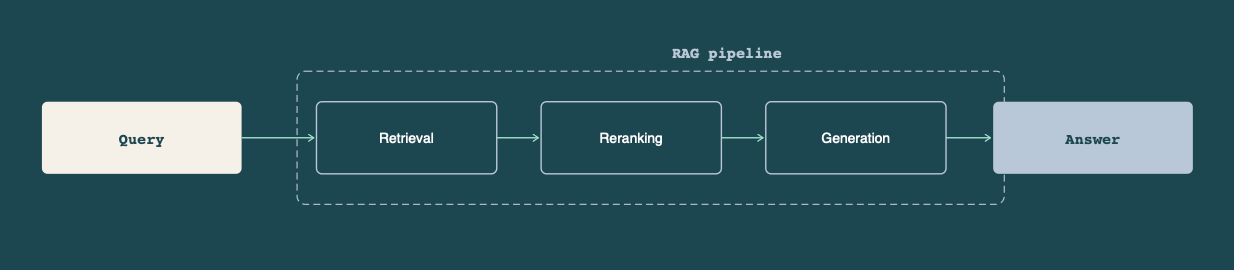
Classic RAG addresses both problems by adding a retrieval step. Before the language model generates its response, the system:
- Takes the user's query
- Converts it into a vector embedding
- Searches an indexed knowledge base for the most semantically similar passages
- Retrieves the top-k most relevant chunks
- Passes those chunks to the language model as context
- Generates a response grounded in the retrieved content
This was genuinely transformative. It meant AI systems could answer questions about internal documents without baking that content into the model itself. It meant answers could be grounded in current information rather than stale training data. It meant enterprises could deploy AI on their own knowledge without sending that knowledge to a third-party model.
For a certain class of queries — relatively simple, single-document, well-defined questions — it works well.
Where Classic RAG Breaks Down
The problem is that enterprise knowledge work is rarely simple, single-document, or well-defined.
Classic RAG has several structural constraints that become significant when the questions get hard:
Single-pass retrieval
Classic RAG runs one retrieval operation per query. It fetches the top-k passages most similar to the original question — and those passages are the only context the model gets. If the relevant information is spread across multiple documents, or requires cross-referencing two sources against each other, a single retrieval pass almost certainly won't capture all of it.
Ask "Which of our supplier contracts have payment terms inconsistent with our procurement policy?" and a classic RAG system faces an immediate problem: answering that question requires retrieving from multiple contracts and the procurement policy and reasoning about the relationship between them. A single retrieval pass won't get there.
No query understanding or decomposition
Classic RAG treats the user's query as a search string. It converts it to a vector and finds similar content. It doesn't understand the query — it doesn't break it down into sub-questions, identify what kinds of information are needed, or plan a strategy for answering it.
Complex questions are implicitly multi-part. "Are our contracts aligned with the new EU regulation, and which ones expire before we need to comply?" is actually four or five questions compressed into one. Classic RAG has no mechanism for recognising that or acting on it.
Fixed context window, fixed retrieval depth
The number of passages RAG retrieves is a parameter set at design time — typically somewhere between three and twenty chunks. For simple questions, that's fine. For questions that require synthesising information across dozens of documents, it's a hard ceiling on what the system can know when generating its response.
Miss a relevant passage in retrieval and the model generates its answer without it — and usually has no way of knowing it missed anything.
No iteration or self-correction
Once classic RAG retrieves its chunks and passes them to the model, the process is complete. The system doesn't check whether the retrieved content was actually sufficient to answer the question. It doesn't recognise gaps. It doesn't go back and retrieve more. It generates whatever response it can based on what it has — which may be incomplete, partially relevant, or subtly misaligned with what was actually being asked.
Single source type
Most classic RAG implementations are built around one type of source: text documents. They index text, they retrieve text, they answer from text. Structured data in databases, information locked in tables or spreadsheets, content in diagrams or scanned images — these either require separate systems or simply aren't accessible at all.
What AI Agentic Search Does Differently
AI Agentic Search is not classic RAG with better retrieval. It's a fundamentally different architecture — one built around the idea that answering complex questions requires planning and reasoning, not just retrieval.

The key shift is this: instead of treating a query as a search string to be matched, an agentic system treats it as a problem to be solved.
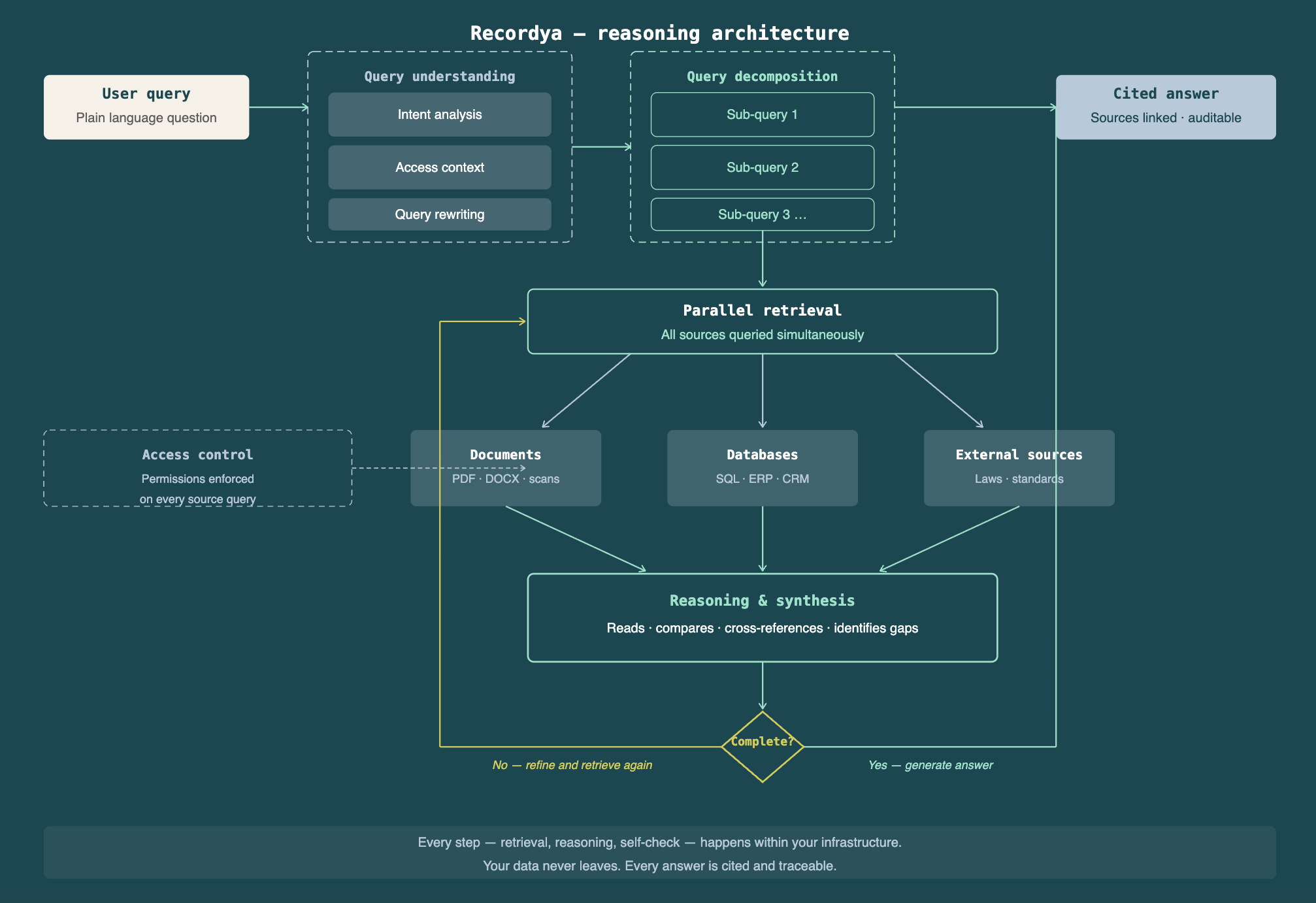
Query planning and decomposition
When a user asks a complex question, an agentic system begins by analysing it. What is actually being asked? What information is needed? What sources are relevant? What sub-questions need to be answered first?
This planning step — which classic RAG skips entirely — is what allows the system to handle questions that are genuinely multi-part, cross-source, or temporally complex.
"Are our top suppliers by spend compliant with the new procurement directive, and do any of their contracts expire before the compliance deadline?" becomes a plan: retrieve spend rankings from the ERP, retrieve contract terms and expiry dates from contract documents, retrieve the relevant articles from the external regulatory source, then reason across all three to produce a consolidated answer.
Multi-source, parallel retrieval
An agentic system doesn't retrieve from one source. It retrieves from all relevant sources simultaneously — documents, databases, external feeds, structured and unstructured data — and holds all of that context together.
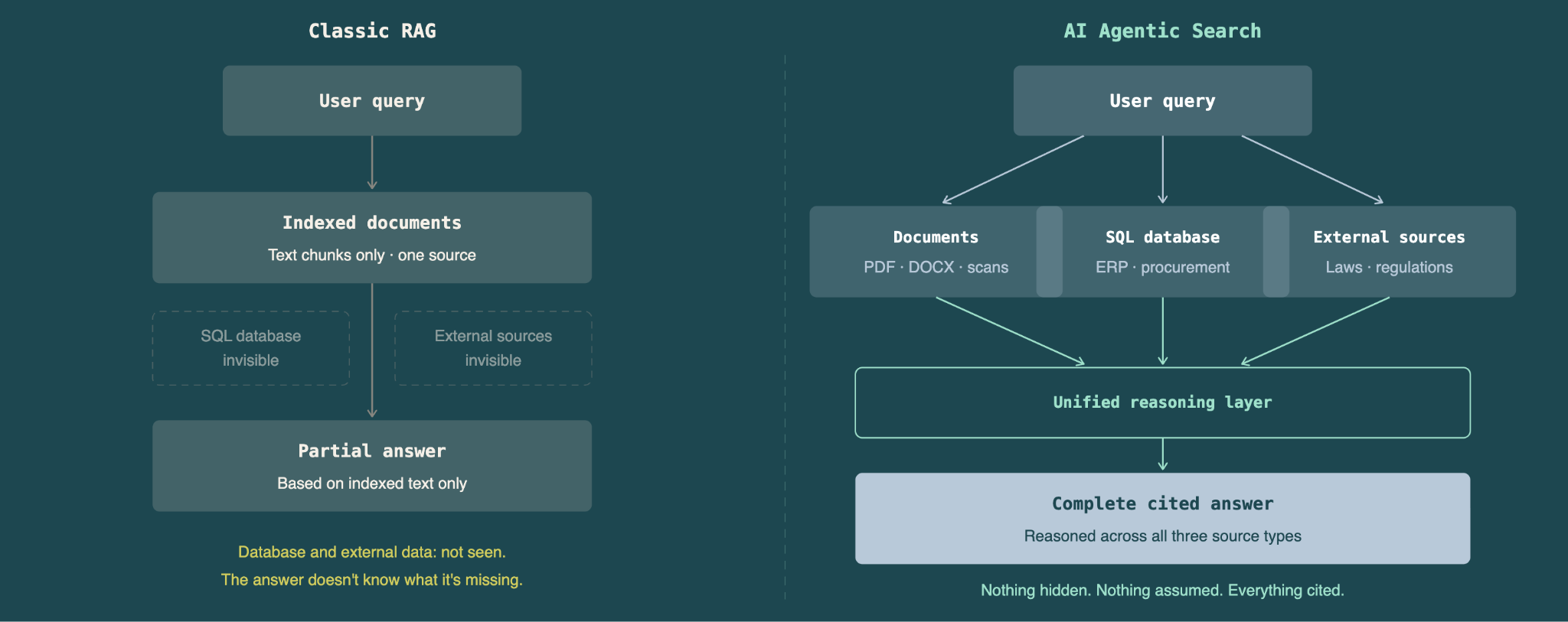
This is what makes questions like "Does what our contract says match what the regulation now requires?" answerable. The contract lives in a PDF. The regulation lives in an external legal database. Classic RAG can see one or the other. An agentic system sees both — and reasons across them.
Iterative retrieval and self-correction
If the first retrieval pass doesn't yield sufficient information, an agentic system recognises the gap and retrieves again — with a refined query, a different source, or a different framing. It doesn't stop until it has what it needs to answer the question well, or until it can explicitly flag what's missing.

This iterative loop is one of the most practically significant differences. It means the system can handle questions where the right retrieval strategy isn't obvious upfront — questions where you discover what you need to know only after you've started looking.
Reasoning across retrieved content
Classic RAG passes retrieved chunks to a language model, which generates a response. The reasoning happens in a single step, on a fixed context. Agentic search reasons continuously — comparing what it finds across sources, identifying contradictions, flagging gaps, connecting facts that appear in separate documents.
This is the capability that makes genuinely analytical questions answerable. Not "What does this contract say about liability?" but "How does what this contract says about liability compare to our standard template, and does it create any exposure we haven't accounted for?"

Full multi-modal coverage
Enterprise knowledge doesn't live only in text. Tables in spreadsheets, data in databases, information in scanned documents and diagrams — all of it matters. Agentic search is built to handle this full range: querying databases directly via SQL, extracting structured data from tables, reading information from charts and diagrams, and integrating it all into a single coherent response.
A Direct Comparison

The Same Question, Two Systems
To make this concrete, consider a question a procurement manager might actually need to answer:
"Which of our active supplier contracts in the electronics category have payment terms longer than net-45, and do any of them conflict with our updated procurement policy from Q1 2026?"
Classic RAG:
The system retrieves the most semantically similar passages from its indexed documents — likely some contract clauses mentioning payment terms, possibly a section of the procurement policy. It generates a response based on whatever passages happened to score highest in similarity. It probably misses some contracts. It almost certainly can't confirm whether it found all relevant clauses. It may not have access to the updated Q1 2026 policy at all if the index hasn't been refreshed. The answer is partial at best, and the system has no way to tell you how partial.
AI Agentic Search (Recordya):
The system recognises this as a multi-part question: find all active contracts in the electronics category, identify payment terms in each, compare to the net-45 threshold, retrieve the Q1 2026 procurement policy, check each contract against the updated policy. It queries the contract database and relevant PDFs in parallel. It reads the policy document in full. It compares each contract's terms against both the threshold and the policy requirements. It returns a structured answer: three contracts exceed net-45, two of those have terms that predate and therefore don't reflect the Q1 2026 policy update, one requires immediate review.
Every claim is cited. Every source is traceable. Nothing was left to chance or similarity scoring.
When Classic RAG Is Sufficient
It's worth being honest: classic RAG isn't wrong for every use case. There are scenarios where its architecture is perfectly adequate.
Classic RAG works well when:
- Questions are simple and well-scoped ("What is our vacation policy?")
- The answer lives in a single, well-defined document
- The knowledge base is relatively small and homogeneous
- Users are asking lookup-style questions rather than analytical ones
- Speed matters more than depth or completeness
If your use case is primarily a Q&A system over a single knowledge base — an internal FAQ bot, a product documentation assistant, a simple policy lookup tool — classic RAG may be entirely sufficient.
The calculus changes the moment your use case involves:
- Multiple document types and data sources
- Questions that require synthesis or comparison across sources
- Compliance or legal work where completeness and accuracy are non-negotiable
- Queries that are inherently multi-part or temporally complex
- Structured data in databases alongside unstructured documents
For these cases — which describe most serious enterprise knowledge work — classic RAG's architectural limits aren't edge cases. They're the central problem.
What to Ask When Evaluating Systems
If you're comparing RAG-based systems for enterprise use, these questions cut through the marketing:
- Can it decompose a complex question automatically — or does it treat every query as a single search string?
- How many sources can it query in a single response — and can those sources include databases and external feeds, not just indexed documents?
- What happens when the first retrieval pass is insufficient — does it try again with a refined approach, or return whatever it has?
- Can it reason across documents — compare, contrast, identify gaps, flag conflicts — or does it simply summarise the most relevant passages?
- How does it handle structured data — can it query a SQL database directly, or only text it previously indexed?
- Are answers fully cited — can every claim be traced to a specific source, page, and passage?
- What does failure look like — does the system tell you when it can't find a complete answer, or does it confabulate?
The last question is often the most revealing. A system that knows what it doesn't know is far more trustworthy in enterprise contexts than one that always produces a confident-sounding answer.
The Bottom Line
Classic RAG was a breakthrough. It made AI useful for internal knowledge in a way that wasn't possible before. But it was designed for a narrower problem than the one most enterprises actually face.
AI Agentic Search is built for the full complexity of enterprise knowledge work — questions that span multiple sources, require genuine reasoning, and need to be right, not just plausible. The architecture is different not because it's more impressive, but because the problem demands it.
If your teams are asking simple questions, classic RAG will serve you well. If they're asking the kinds of questions that currently require an analyst to spend half a day reading through folders — that's where agentic architecture earns its place.
See It in Action with Recordya
Recordya is built on AI Agentic Search architecture. It connects to your documents, databases, and external sources, decomposes complex queries automatically, and returns precise, cited answers — without sending your data outside your infrastructure.
Schedule a demo → Bring your hardest document question. We'll show you what the answer looks like.