

TL;DR
Real business questions don't respect the line between "document" and "database." A single query — why a shipment is late, whether a promotion is defensible — often needs a contract PDF, an email thread, a scanned image, and a live ERP or HRIS field, all at once. Most enterprise search tools stop at the document boundary and leave employees to reconcile the rest by hand, a fragmentation IBM research puts at $3.1 trillion a year in lost productivity and revenue. Recordya connects directly to SQL, ERP, and HRIS systems alongside documents, with multimodal understanding for tables, scans, and images, and reasons across all of it in a single cited answer.
The question doesn't know it's supposed to stay in one system
Ask a procurement lead why a shipment is late, and the honest answer lives in four places at once: a signed contract PDF, an email thread negotiating a delivery clause, a scanned photo of a damaged pallet, and a status field in the ERP. Ask an HR business partner whether a promotion is defensible, and the answer needs a policy document, a performance review, and a salary band pulled straight from the HRIS. None of these questions were written with a system boundary in mind. The person asking doesn't think "I need the document system for this part and the database for that part." They just want to know what happened.

Most search tools stop where the database begins
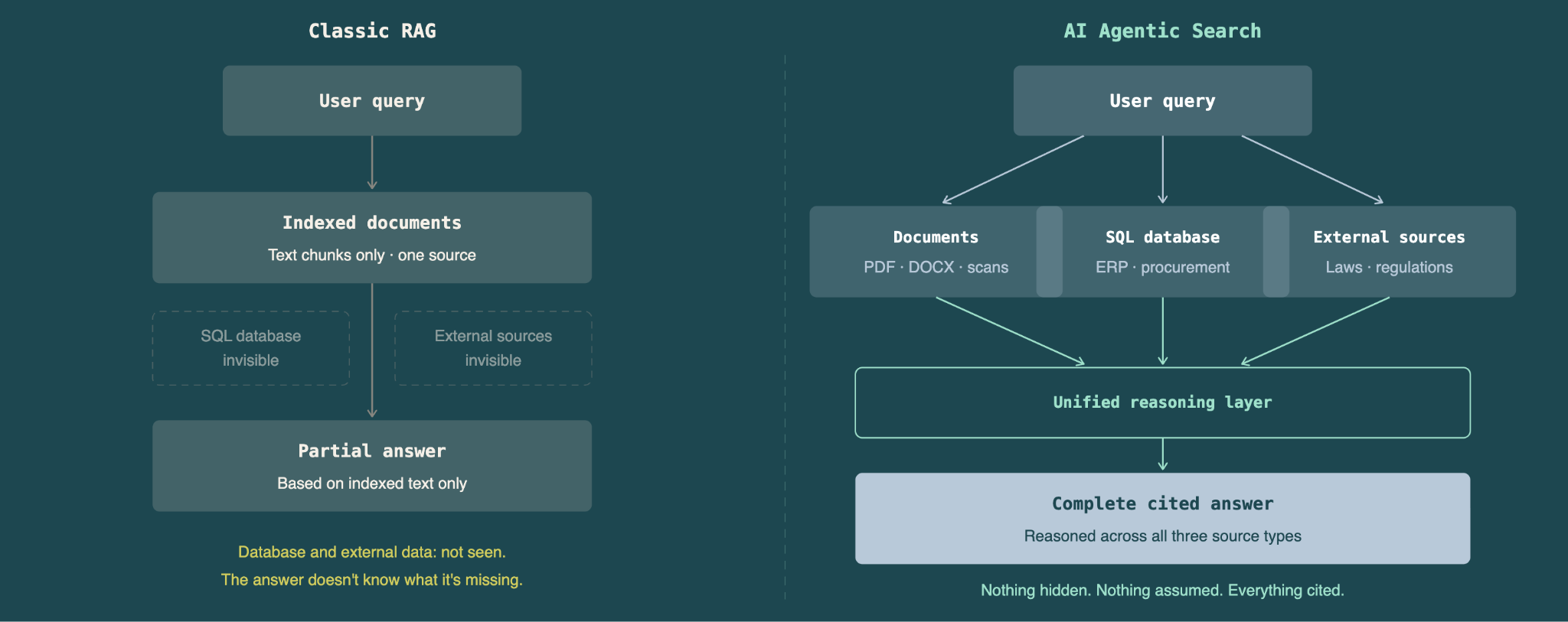
Most enterprise search tools were not built for that. They index documents — PDFs, Word files, wikis, slide decks — and stop exactly where the database begins, returning a list of files instead of an answer (a gap we've written about in why keyword search fails in enterprise document management). Structured data, the kind that lives in SQL tables, ERP records, and HRIS fields, is treated as a separate problem, owned by a separate team, queried through a separate interface. And the fastest-growing chunk of what companies actually hold isn't even text: it's tables buried inside PDFs, charts in board decks, scanned forms, product photos with damage annotations, engineering diagrams. Industry estimates put unstructured and semi-structured data at somewhere around 80–90% of everything an enterprise stores, and it's growing several times faster than the structured data sitting next to it. A search tool that only reads clean text is already missing most of the picture, and it was never going to reach the database at all.
What a single answer might actually require
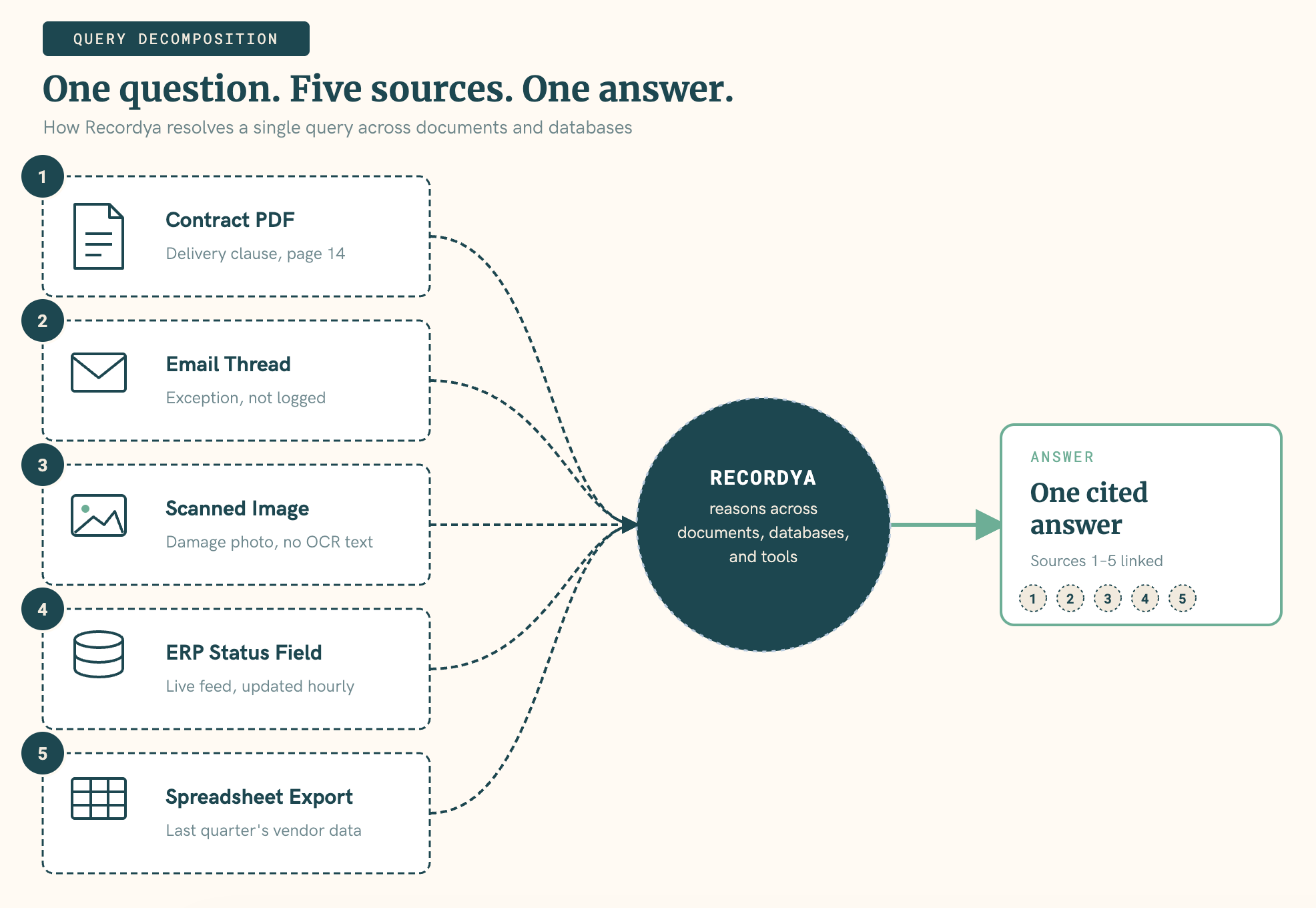
Take that shipment question again and break it into what it's really asking for. One "simple" query can touch:
- A contract PDF — the delivery clause and penalty terms, often buried on page 14
- An email thread — the negotiated exception nobody updated the contract to reflect
- A scanned image — a damage photo or handwritten inspection note with no searchable text
- An ERP status field — the current shipment stage, updated an hour ago
- A spreadsheet export — last quarter's vendor performance, sitting on someone's desktop
A tool that only reaches one or two of these isn't answering the question. It's answering a smaller, safer version of it — and leaving the person asking to fill in the rest by hand.
When the gap becomes the employee's problem
When the system that answers "what does the contract say" is not the system that holds "what does the ERP say," the work of connecting them falls on whoever asked the question. They open the document platform, then the ERP, then maybe export a spreadsheet, then reconcile the two by hand — trusting that the export was current and that they read the right version of the contract. IBM research, still widely cited today, put the annual cost of poor data quality and fragmentation at $3.1 trillion in lost productivity and revenue across the U.S. economy, and DATAVERSITY's 2025 data management trends survey found 68% of organizations now name data silos their top concern, up 7 points from the year before. Those aren't abstract numbers. They're the accumulated minutes of every employee who had to open a second tab, run a second query, and manually merge what should have been one answer.
The risk isn't just time. It's the version of truth someone ends up trusting. A finance analyst who pulls a number from a table screenshotted into a slide deck two quarters ago, because that's what the search tool surfaced, may never know the ERP has since been corrected. A legal reviewer who reads a contract clause in isolation, without the amendment logged as a structured record in the contract management system, may miss that the clause no longer applies. Fragmented answers don't just waste time — they quietly erode confidence in the answer itself, which is the one thing a search system exists to provide.
Reading the whole company, not just the document repository
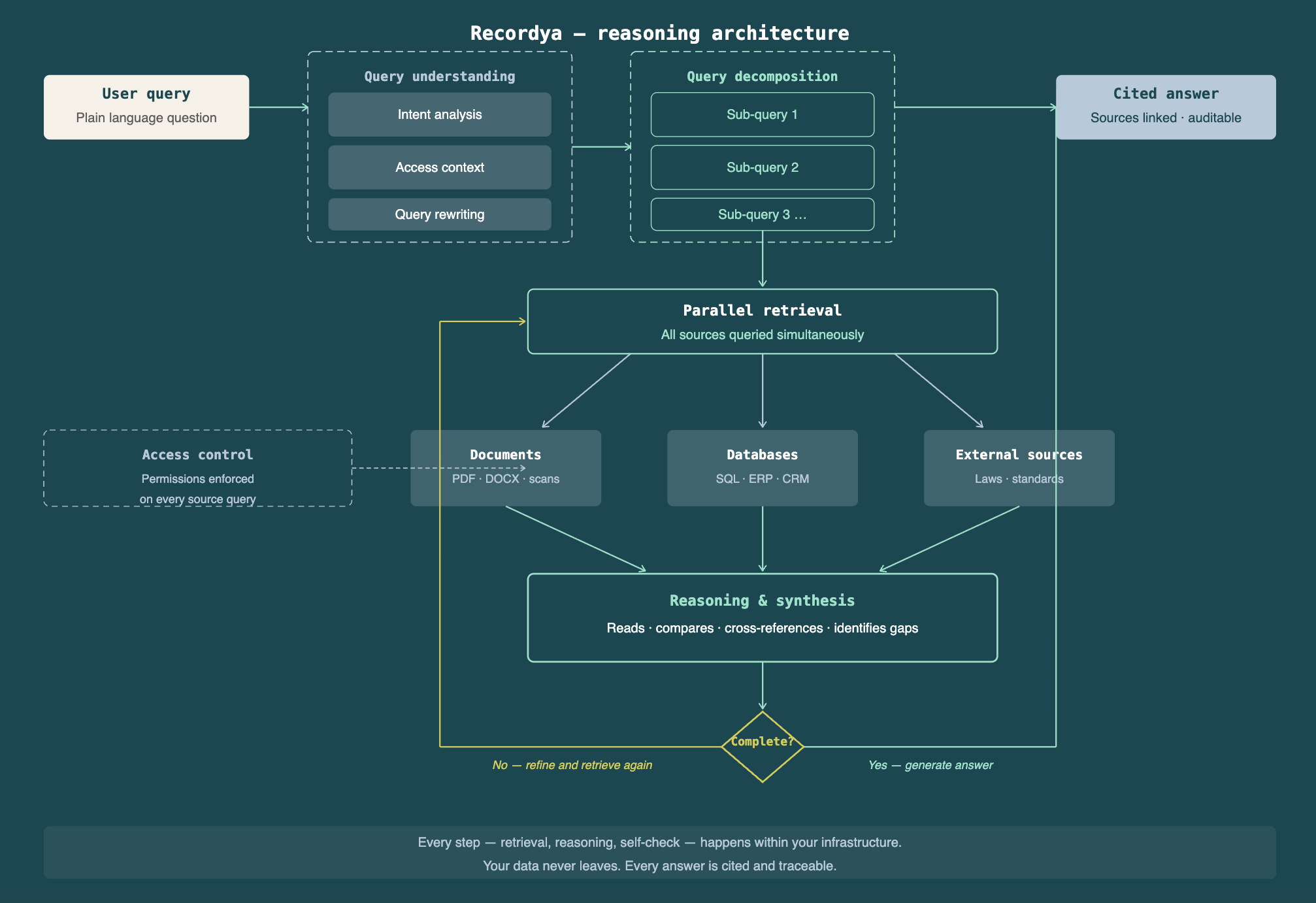
This is the premise Recordya is built on: a question doesn't care which system holds the answer, so the retrieval shouldn't either. Recordya connects directly to structured sources — SQL databases, ERP systems, HRIS platforms — alongside the document repositories it already indexes, and its multimodal understanding extends that same reasoning to tables embedded in PDFs, charts, scanned forms, and images with meaningful visual content.

When a question touches multiple sources, query decomposition breaks it into the sub-questions each system can actually answer, retrieves from documents and databases in parallel, and reasons across the combined result before responding — with citations back to every source it drew from, structured or not. The full mechanics of how the retrieval and reasoning layers work together are covered in Recordya's technology overview.
Where this shows up in practice
That procurement lead asking about the late shipment gets one answer that already accounts for the contract terms, the email context, the damage photo, and the current ERP status — not four separate lookups they have to reconcile themselves. The HR business partner gets the policy, the review, and the salary band together, with each figure traceable to where it actually lives. The system does the cross-referencing that used to be the employee's unpaid second job. More examples of this across departments are in Recordya's use case library.

The boundary was never the point
None of this makes the underlying systems go away — Recordya doesn't replace the ERP or the HRIS, and it isn't meant to. It sits alongside them as the layer that reads across all of them at once, on-premises, within the same access controls that already govern who can see what. The goal was never to add another place to search. It was to make the boundary between "document" and "database" invisible to the person who was never supposed to know it existed in the first place.
See it on your own data
The fastest way to know whether this closes a real gap for your team is to run it against a question you actually have — one that currently takes a contract, an inbox, and an ERP tab to answer.