


"Agentic" has become one of those words every enterprise search vendor now puts on their homepage, regardless of what their system actually does. That makes evaluation harder, not easier — the marketing language has converged even as the underlying capabilities have not. A tool that returns a ranked list of passages and a tool that reads across fifty documents, reconciles conflicting policy versions, and cites its sources can both claim to be "agentic," and from a demo alone it's not always obvious which one you're looking at.
If you're assessing whether to move beyond your current setup, these are the capabilities that separate genuinely agentic systems from marketing-inflated alternatives. For a closer look at where the line actually falls, see our breakdown of classic RAG vs. AI agentic search.
TL;DR
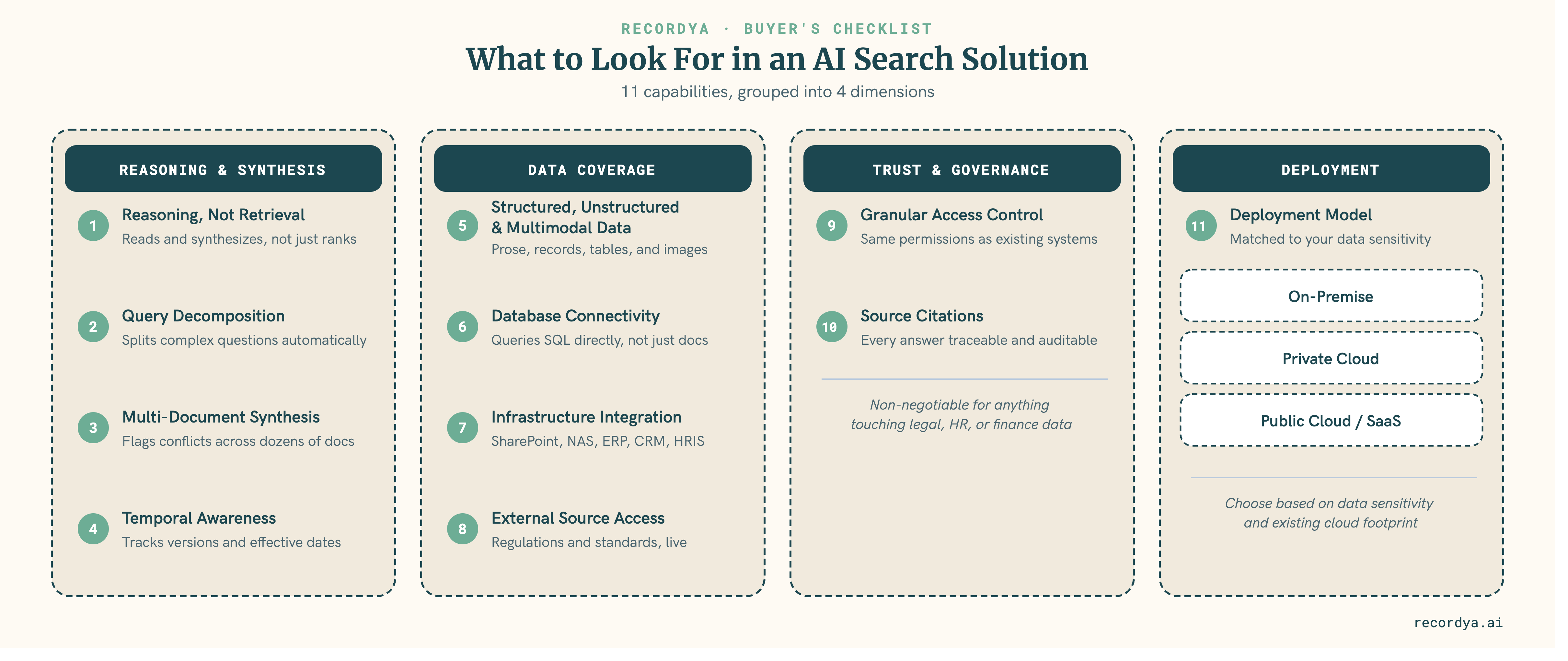
- Reasoning, not retrieval — the system reads and synthesizes across documents, not just ranks passages
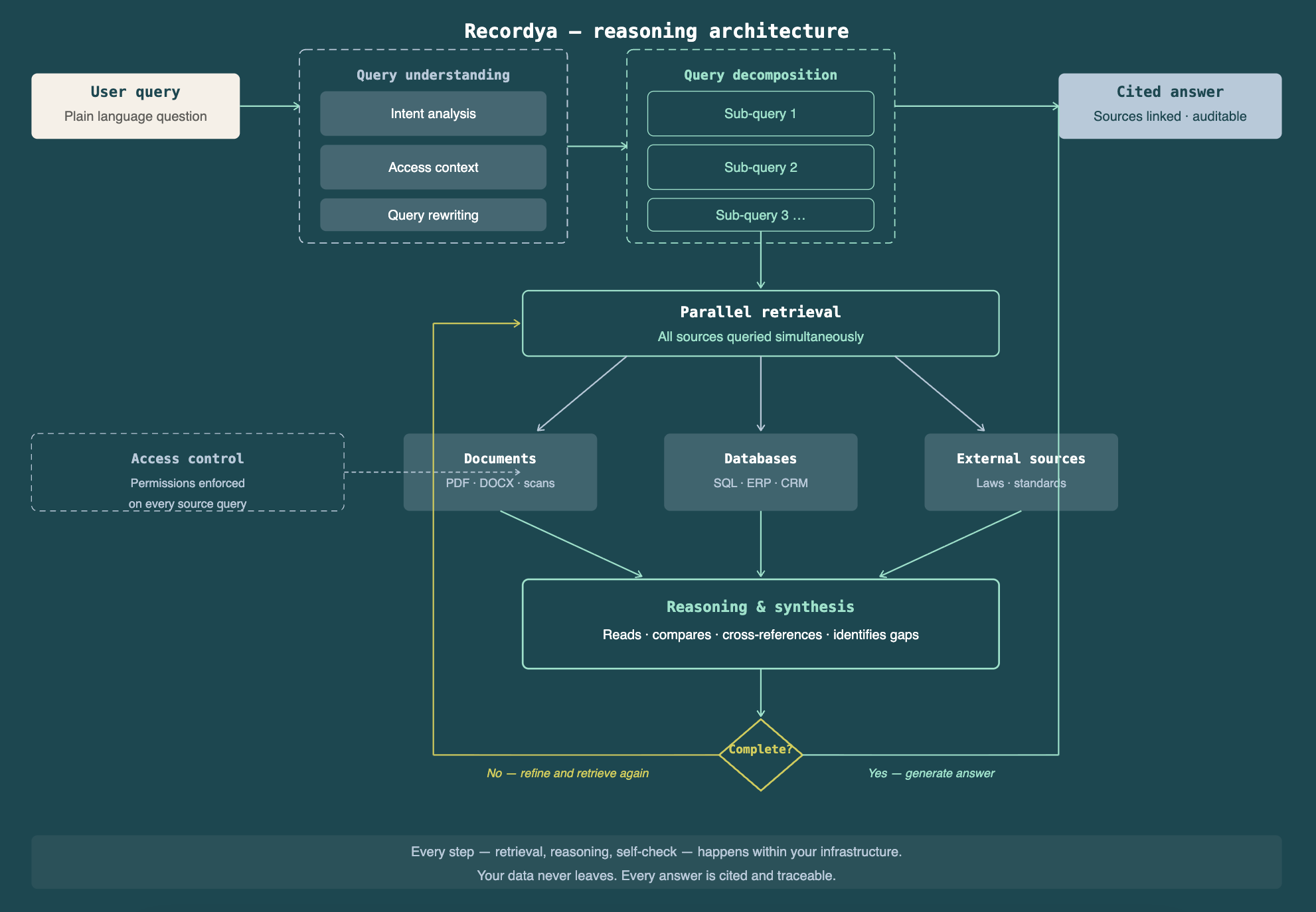
- Query decomposition — breaks complex, multi-part questions into coordinated sub-searches automatically
- Multi-document synthesis — holds context across dozens of documents and flags conflicts and connections
- Temporal awareness — understands document versions, effective dates, and changes over time
- Structured, unstructured, and multimodal data — handles prose, database records, and tables, images, and diagrams alike
- Database connectivity — queries SQL directly and blends it with document content in a single answer
- Infrastructure integration — connects to SharePoint, NAS, ERP, CRM, HRIS, and more without migrating anything
- External source access — reasons across live external sources like legislation and industry standards
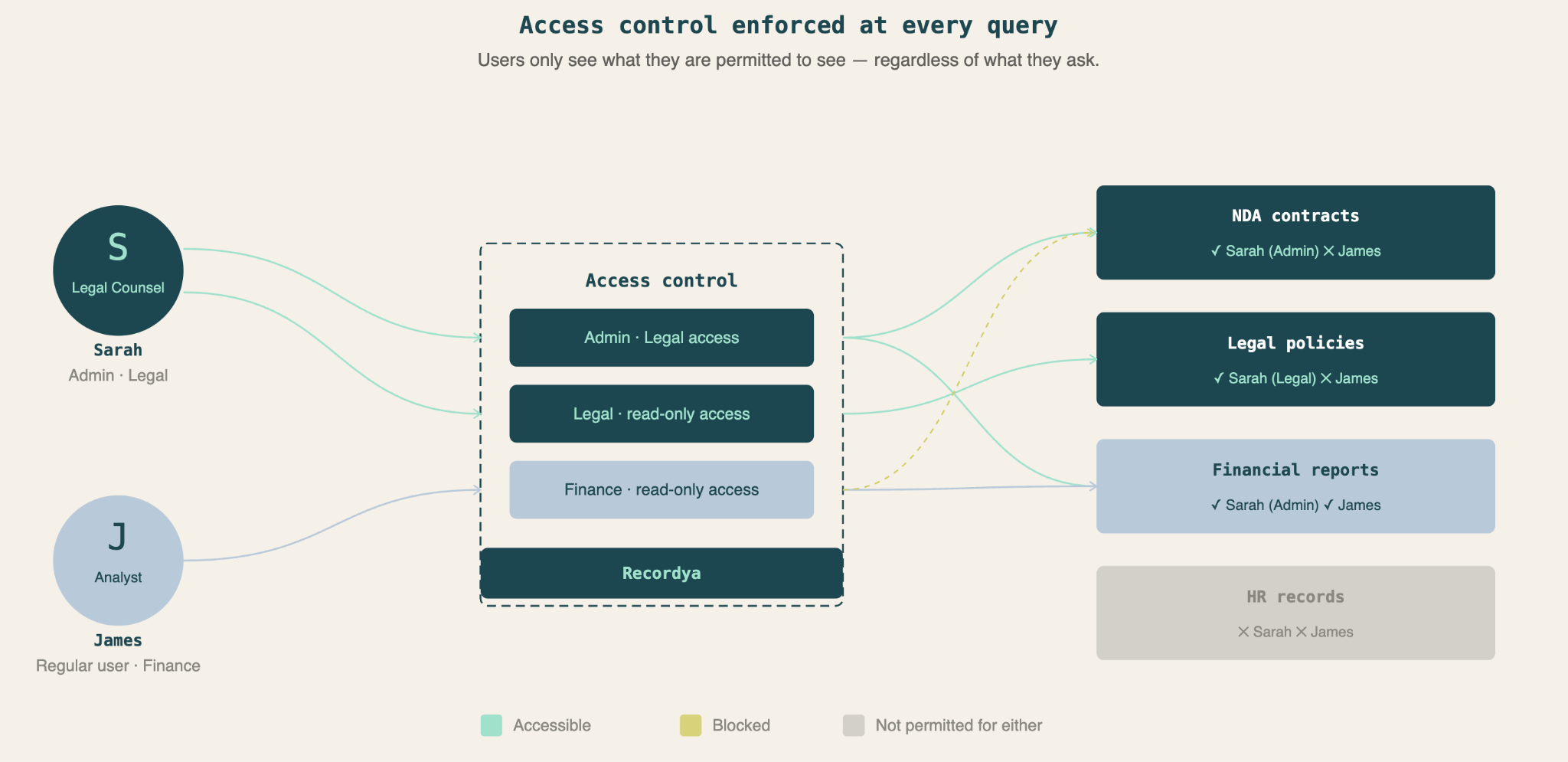
- Granular access control — enforces the same permissions as your existing systems
- Source citations — every answer is traceable and auditable
- Deployment model — on-premise, private cloud, or public cloud, matched to your data sensitivity
- Want to see how Recordya checks each of these boxes? Schedule a demo and walk through your own documents live
What Is Agentic AI Search?
Agentic AI search describes a class of AI agents built specifically to plan, execute, and reason through information-retrieval tasks without a human stitching each step together manually. Where a traditional search bot matches keywords or embeddings against an index, an AI agent treats the query itself as a problem to solve: it decides which sources to check, in what order, whether one search is enough or the question needs to be broken apart, and how to reconcile what it finds before handing back an answer.
That distinction matters because "AI agent," like "agentic," has become a label applied loosely across the market. A genuine AI agent for enterprise search shows a few defining traits: it operates with real autonomy over its own search strategy, it can call multiple tools or data sources within a single query — a vector index here, a SQL database there, an external regulatory feed elsewhere — and it evaluates its own intermediate results well enough to know when to search again rather than settling for the first plausible answer.
How AI Agents Work in Enterprise Search
Most production-grade agentic AI search systems, Recordya included, are built as multi-step agent pipelines rather than a single monolithic model. An orchestration layer interprets the user's question and plans a route to the answer; retrieval agents execute that plan across documents, databases, and external sources; and a synthesis step combines whatever comes back into one coherent, cited response. This agentic AI architecture is what lets the system handle a compound legal question, a multi-year policy comparison, or a query that spans a contract and a database — all inside a single conversational exchange.
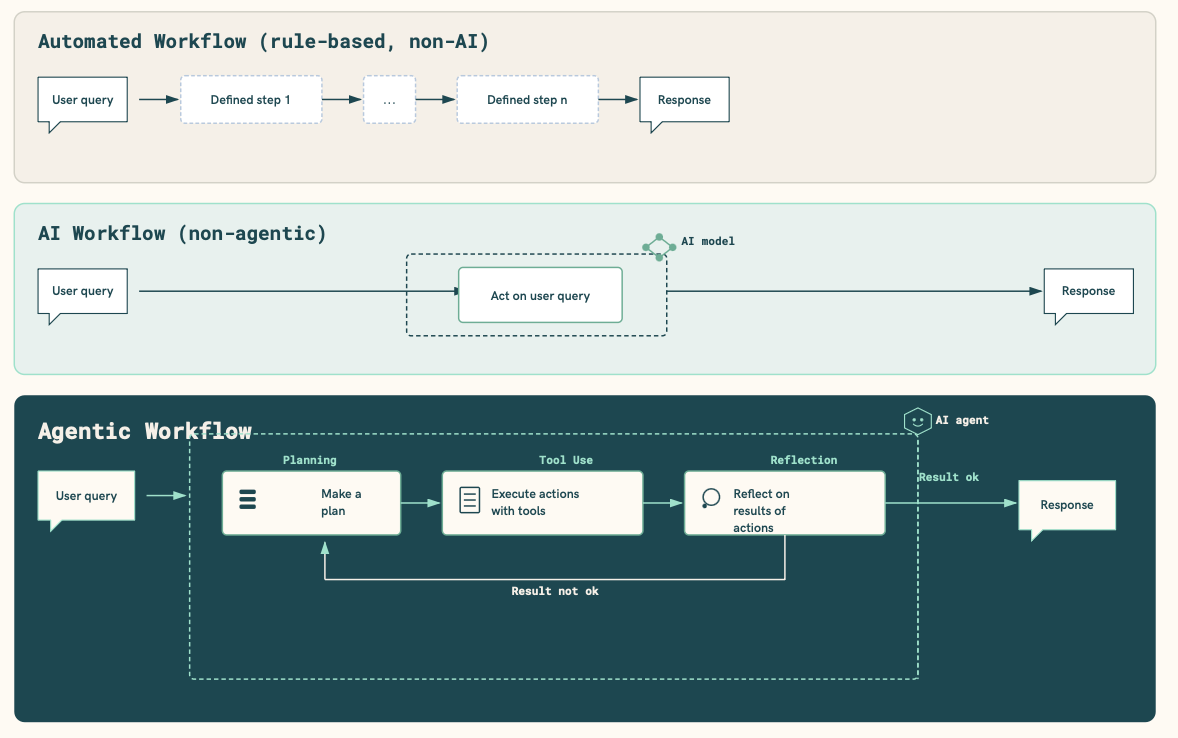
The practical upshot for buyers: when evaluating AI agents for enterprise search, the questions that matter aren't about model size or how "smart" the underlying LLM sounds in a demo. They're the operational ones covered in the checklist below — does the agent decompose the query, does it reason across multiple documents, does it respect access controls, is every step of its reasoning traceable back to a source. AI agents that skip these fundamentals are chatbots wearing agentic branding.
Where RAG Fits In
Most agentic AI search systems are built on top of Retrieval-Augmented Generation (RAG) — the technique of grounding a language model's answer in retrieved documents rather than its training data alone, so responses are based on your actual content instead of general knowledge or guesswork. RAG is what makes source citations and up-to-date answers possible in the first place; without it, a model is working from memory, which is exactly how hallucinations happen.
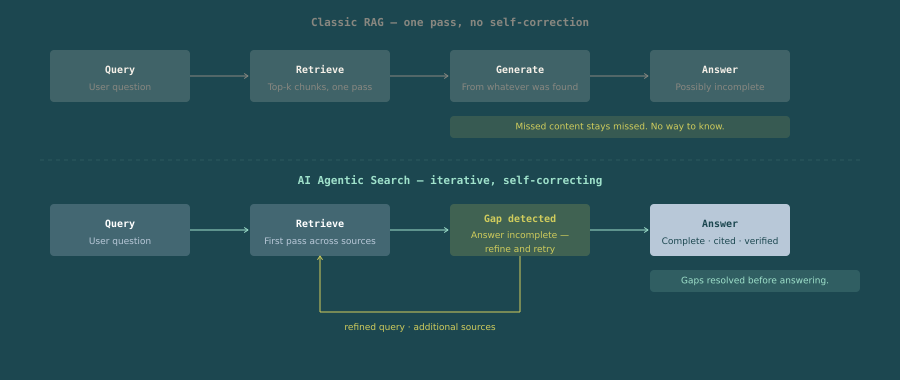
Agentic AI search doesn't replace RAG, it extends it: instead of a single retrieve-then-generate pass, an agent decides when to retrieve, from where, how many times, and how to combine results before generating a final answer. For a deeper look at how RAG works and why it matters for enterprise knowledge management, see our explainer on Retrieval-Augmented Generation.
Core Capabilities to Evaluate in an AI Search Solution
Reasoning, Not Just Retrieval
The first question to ask is the most basic one: does the system actually read and reason across the documents it finds, or does it just return ranked passages and leave the synthesis to you? Search that stops at retrieval is still search — we've written before about why keyword search fails in enterprise document management for exactly this reason. Something that pulls in relevant material, weighs it, and produces an answer is doing a fundamentally different job — and that job is the one your employees actually need done.
Query Decomposition
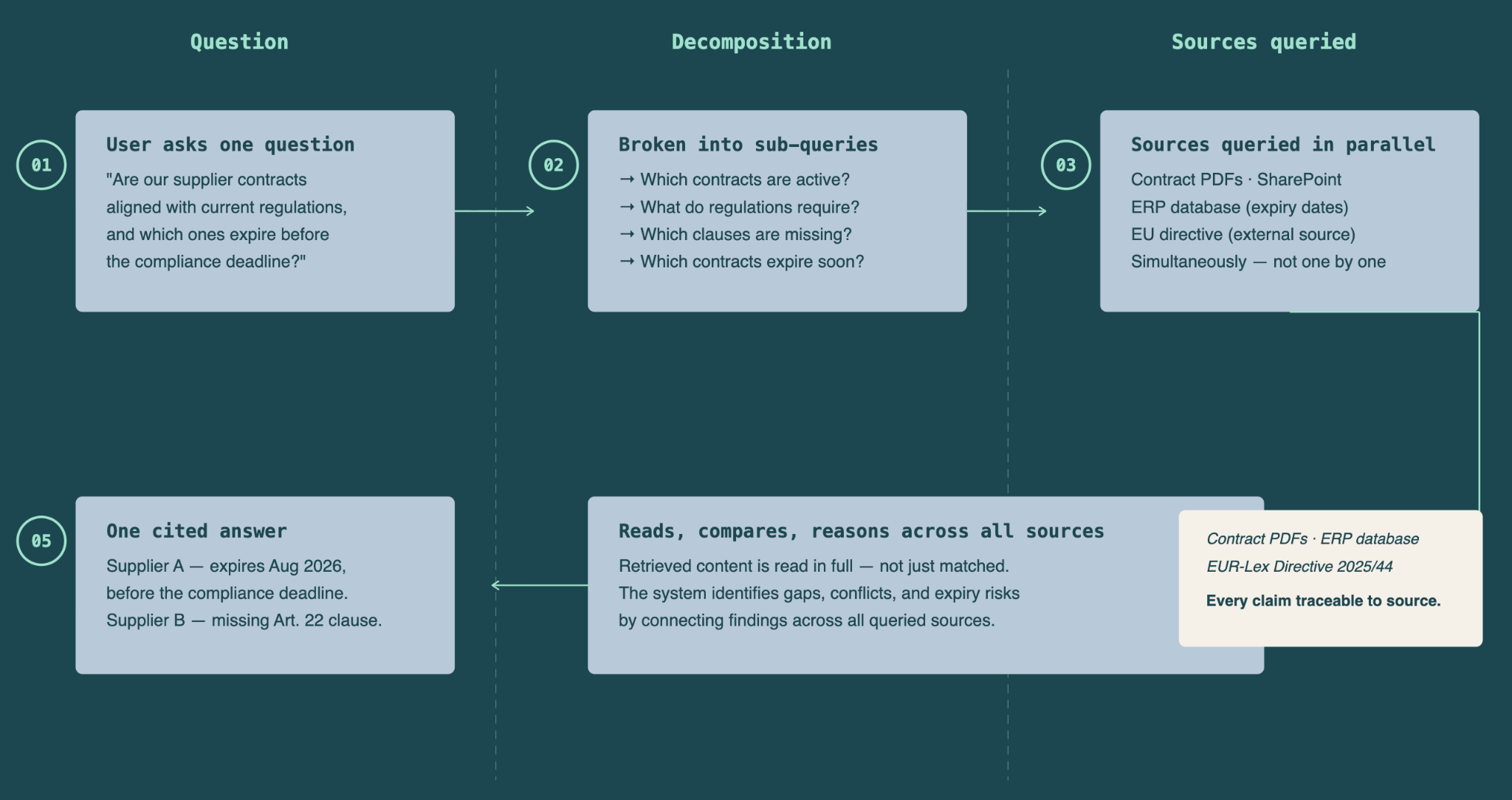
Real questions rarely arrive as single, clean lookups. "What's our current parental leave policy, how does it differ from the 2023 version, and does it apply to contractors?" is really three questions stitched together. Can the system break a complex, multi-part question into coordinated sub-searches automatically, or does it choke on anything more layered than a keyword?
Multi-Document Synthesis
Can it hold context from dozens of documents simultaneously and identify connections, conflicts, and changes? This is where most retrieval-only tools fall apart — they can find the ten most relevant documents, but they can't tell you that two of them contradict each other, or that a third one supersedes both. Recordya's synthesis layer exists specifically to close this gap, combining results from multiple sources into one coherent, sourced answer rather than a pile of individually-relevant fragments.
Temporal Awareness and Document Versioning
Documents change. Policies get revised, contracts get amended, procedures get updated — and the old versions rarely disappear from the file system. Can the system reason about document versions, effective dates, and changes over time, or will it confidently hand you a policy that was replaced eighteen months ago?
Structured vs. Unstructured Data — and Where Multimodal Fits
Enterprise information doesn't live in one shape, and most search tools are only built to handle one of them. It's worth being precise about the distinction when you evaluate a vendor.
Unstructured data is prose: contracts, policies, emails, meeting notes, PDFs. Structured data is rows and columns: your SQL databases, ERP, HRIS, CRM. Most "AI search" tools are really document search tools — they were built for the unstructured side and treat structured systems of record as out of scope entirely. This split is also where classic RAG for knowledge management tends to hit its limits, since it was designed around text retrieval rather than structured records.
In between sits a third category that's easy to overlook: tables, images, and diagrams embedded inside otherwise unstructured documents. A pricing table in a contract, a org chart in a policy PDF, a schematic in a technical spec — this is multimodal content, and it's semi-structured by nature. A search tool that only reads paragraphs is blind to it, which means it's blind to a meaningful share of what actually carries the information in enterprise documents.
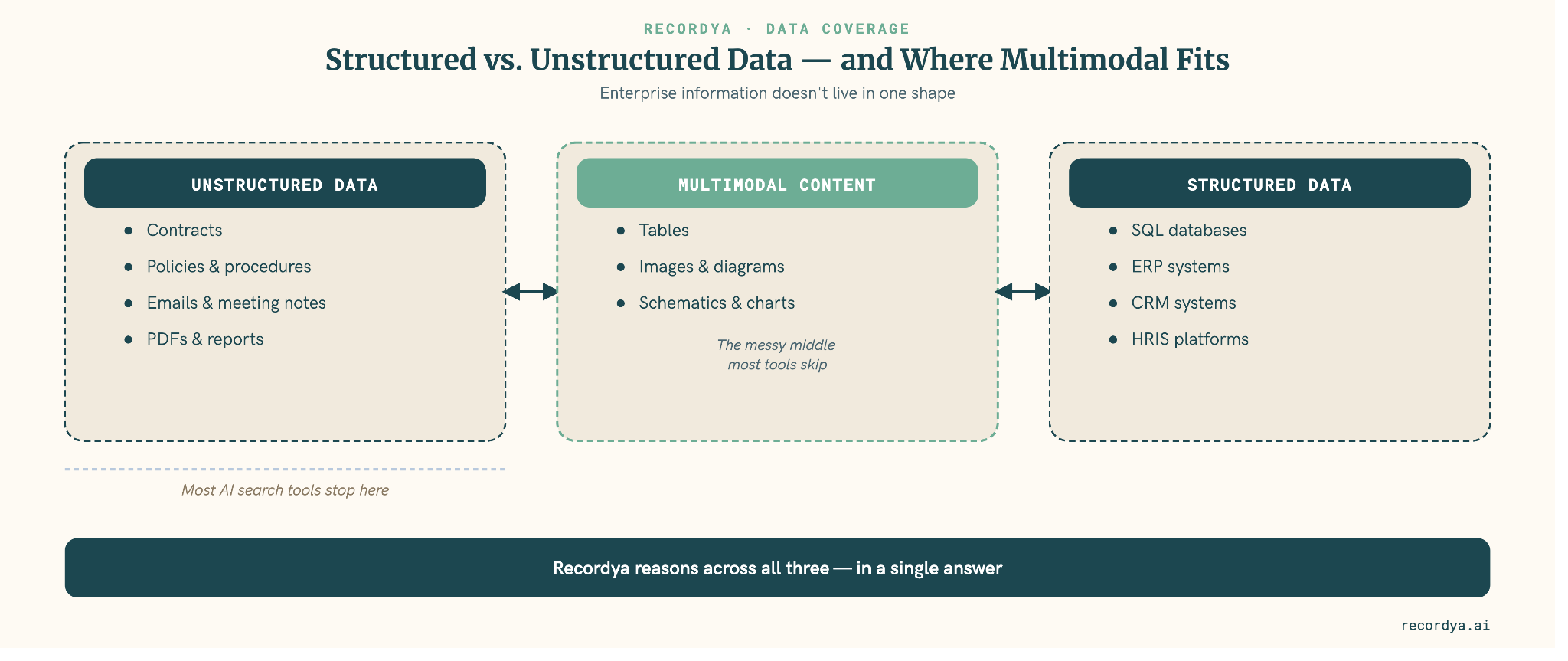
A genuinely agentic system needs to handle all three: unstructured prose, structured records, and the multimodal content sitting between them. Ask vendors directly whether tables and images are indexed and reasoned over, or just skipped during ingestion — the gap between those two answers is larger than it sounds in a demo.
Database Connectivity
Can it query your SQL databases directly, not just indexed documents — and can it combine structured database data with unstructured document content in a single answer? The most useful answers often require both: a policy from a document and a number from a system of record, brought together in one response.
Infrastructure Integration
Database connectivity is really one instance of a broader requirement: can the system connect to the infrastructure where your information actually lives, rather than asking you to migrate everything into a new platform first? A search tool that only works with content you've manually uploaded is asking you to solve the wrong problem. In practice, that means integration with sources like:
- File storage — SharePoint, network-attached storage (NAS), file servers, and cloud drives
- ERP systems — SAP, Oracle, Microsoft Dynamics, and similar platforms holding financial, procurement, and operations data
- CRM systems — Salesforce, HubSpot, and similar platforms holding customer and pipeline data
- HRIS platforms — Workday, SAP SuccessFactors, and similar systems holding employee records
- SQL and relational databases — direct queries against your existing data warehouses and operational databases
- Ticketing and knowledge systems — Jira, Confluence, ServiceNow, and comparable tools
The point isn't an exhaustive list of connectors — it's whether the system was designed to sit on top of infrastructure you already run, or whether "integration" turns out to mean a one-time export. See Recordya's available integrations for how this works in practice, and our piece on why a company knowledge base has to meet documents where they live rather than the other way around.
External Source Access
Internal knowledge doesn't exist in a vacuum. Can it be configured to pull from live external sources such as legislation databases, regulatory publications, or industry standards, and reason across those alongside your internal content? For teams in legal, compliance, or regulated industries, this is often the difference between a tool that's merely convenient and one that's actually trustworthy.
Granular Access Control
Does the system respect the same permissions your existing systems enforce, so users only see what they're entitled to see? An AI search tool that flattens your access controls and surfaces HR or legal documents to anyone who asks isn't a productivity gain — it's a liability. This is one of Recordya's core features: access management down to individual files and folders, matching your existing roles and permissions.
Source Citations
Does every answer include traceable references, so conclusions can be verified and decisions can be audited? Answers without citations ask for blind trust. In an enterprise setting, especially anywhere near legal, finance, or compliance, that's not a reasonable ask — we go into this in more detail in AI without hallucinations.
Deployment Model
For sensitive documents, where and how the system runs matters as much as what it can do. Most AI search vendors default to a single, public multi-tenant cloud — which is fine for low-sensitivity content, but a poor fit the moment legal contracts, employee records, or financial data are involved. Evaluate deployment options on their own, separate from features — Recordya's security and deployment model is a useful reference point for what to ask vendors.
On-Premise Deployment
The system runs entirely inside your own data center, on infrastructure you own and control. Documents, embeddings, and query logs never leave your network. This is typically the requirement for organizations in regulated industries — legal, finance, healthcare, government, defense — where contractual or regulatory obligations restrict where data can physically reside. The trade-off is operational: your team takes on the hosting, scaling, and maintenance work that a managed service would otherwise handle.
Private Cloud Deployment
The system runs in a dedicated, single-tenant cloud environment — either your own cloud account (AWS, Azure, GCP) or a vendor-managed private instance — rather than shared infrastructure. You get isolation from other customers' data and more control over data residency and retention, without owning physical hardware. This is often the practical middle ground: close to on-premise levels of control, with less infrastructure burden.
This option really only makes sense if your organization already operates that way. If your other enterprise systems already run in your own AWS, Azure, or GCP account, deploying search into that same environment is a natural extension — it fits existing security policies, network boundaries, and vendor relationships. If your organization has no existing cloud footprint, standing one up solely to host a private instance of a search tool adds cost and complexity without a clear offsetting benefit, and on-premise or public cloud is usually the more sensible starting point.
Public Cloud / SaaS
The system runs on the vendor's shared, multi-tenant infrastructure. It's the fastest to deploy and the lowest overhead, and for less sensitive internal content it's often a reasonable choice. The question to ask here is what actually enforces separation between your data and other customers' data — and whether the vendor's answer is a contractual promise or an architectural one.
For many organizations — particularly in regulated sectors — the choice between these three isn't a nice-to-have, it's the deciding factor in whether a vendor is even eligible for consideration.
Why This Checklist Matters
None of these capabilities are exotic. They're the baseline for a system that can be trusted with real enterprise questions across legal, HR, finance, procurement, and R&D. The gap between vendors claiming "agentic AI" and vendors building it shows up exactly here — in whether these boxes are actually checked, or just implied by the pitch deck.
Recordya was built around this exact list, not the other way around: agentic reasoning across documents, query decomposition, temporal and multi-document awareness, native handling of structured, unstructured, and multimodal content, external source integration, enterprise-grade access control, full source citations, and on-premises deployment for organizations that need to keep their data in-house. If you're running through this checklist against your current setup and finding gaps, book a demo and we'll walk through where Recordya fits.